
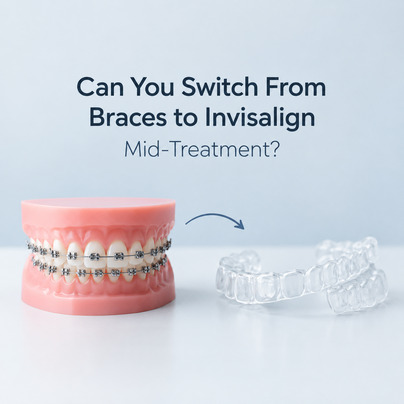
If you started orthodontic treatment with braces but now prefer clear aligners, you may wonder whether you can change treatments before your braces are finished. In many cases, switching from braces to Invisalign is possible.
However, it depends on your teeth, bite and the treatment you still need. Your orthodontist can assess your progress and decide whether Invisalign can achieve the remaining movements.
Why Do People Want to Switch From Braces to Invisalign?
Patients may want to switch from braces to Invisalign for several practical reasons.
A more discreet appearance: Braces have visible brackets and wires, while Invisalign aligners are clear and less noticeable.
Easier eating: Braces can require dietary changes to avoid damaging brackets or wires. Invisalign aligners are removable, so you can take them out when eating.
Easier oral hygiene: Cleaning around brackets and wires can be difficult. With Invisalign, you remove the aligners before brushing and flossing, making your normal oral hygiene routine easier.
Greater comfort: Brackets and wires can irritate the cheeks and lips. Invisalign does not use metal brackets or wires, although the aligners can still cause temporary pressure as your teeth move.
Lifestyle changes: Work, social events or other changes in your routine may make a less visible treatment option more appealing. This can lead patients to ask whether they can change from braces to Invisalign during treatment.
Who Is a Good Candidate to Switch From Braces to Invisalign?
Not every patient with braces is suitable for Invisalign. Your orthodontist will assess several factors before recommending a change.
How much treatment is left
Your orthodontist will consider how much progress you have made and what movements are still required. Someone who needs minor alignment may have different options from someone requiring major bite correction.
Remaining tooth movements
Invisalign can manage many types of tooth movement, but some movements may be better controlled with fixed braces. Your orthodontist may assess remaining crowding, spacing and rotations.
Your bite
Orthodontic treatment must address your bite as well as tooth alignment. If significant bite correction remains, your orthodontist will determine whether Invisalign can achieve the required result.
Your oral health
Healthy teeth and gums are important before continuing orthodontic treatment. Any untreated dental problems may need to be addressed first.
Your compliance
Invisalign aligners are removable, so successful treatment depends on wearing them as instructed. Poor compliance can affect tooth movement and extend treatment.
When Might You Not Be Able to Switch to Invisalign?
Invisalign is not suitable for every orthodontic case. Your orthodontist may recommend continuing with braces if your remaining treatment involves complex movements more predictable with fixed appliances.
While clear aligners work well for mild tracking, clinical data shows that predictability drops for complex adjustments. Vertical movements (extrusion) drop to a 29.6% accuracy rate, and severe tooth rotations fall to 36% accuracy. This affects difficult bite corrections and rotations beyond 15 to 20 degrees, where plastic aligners lose their grip.
Because plastic relies on pushing forces rather than the pulling vectors of wires, fixed braces remain the gold standard for heavy mechanical shifts. Ultimately, suitability varies and a digital assessment is necessary to see if you qualify.
How Do You Switch From Braces to Invisalign?
The process is based on the current position of your teeth and the treatment still required.
1. Your orthodontist assesses your progress: Your orthodontist examines your teeth and bite to determine what has been corrected and what still needs to be treated.
2. Your braces are removed: If Invisalign is suitable, your orthodontist removes your braces at the appropriate stage of treatment.
3. New scans or impressions are taken: Digital scans or impressions record your teeth in their current positions. These records are used to plan your aligners.
4. A new Invisalign treatment plan is created: Your orthodontist plans the remaining tooth movements and determines the aligners needed. Your previous progress is considered when creating this plan.
5. Attachments may be added: Some patients need small tooth-coloured attachments to help their aligners control specific movements.
6. You begin wearing your aligners: Once your aligners are ready, you will receive instructions on how and when to wear them. Regular wear is essential for the planned tooth movements to progress.
Read More: Can You Have Invisalign While Pregnant?
Does Switching From Braces to Invisalign Mean Starting Over?
No, switching from braces to Invisalign does not necessarily mean starting orthodontic treatment again.
The progress made with braces remains part of your overall treatment. However, your orthodontist will need to create a new plan based on your current tooth positions.
The number of aligners you need will depend on how much movement remains. Your treatment may therefore be shorter than a complete Invisalign treatment, although this cannot be determined without an assessment.
How Long Does Invisalign Take After Switching From Braces?
There is no fixed answer to how long Invisalign after braces will take. The timeframe depends mainly on the amount and type of tooth movement still required.
If your teeth are already close to their final positions, treatment may take less time. More complex movements can require a longer treatment period.
Your compliance also matters. Wearing your aligners for the recommended amount of time helps keep treatment on schedule.
Your orthodontist can provide a more accurate estimate after assessing your teeth and creating your Invisalign treatment plan.
| Factor | Braces | Invisalign |
| Appearance | More visible | Less noticeable |
| Removable | No | Yes |
| Eating | Some restrictions | Aligners removed before eating |
| Cleaning | More difficult around brackets | Easier when aligners are removed |
| Compliance | Less dependent on patient wear | Requires consistent wear |
| Complex movements | Can provide strong control | Suitability depends on the case |
Read More: How to Clean Invisalign Retainers
Pros and Cons of Switching From Braces to Invisalign
Before deciding to change treatment, consider both the benefits and drawbacks.
Pros
- Less noticeable during treatment
- Aligners can be removed for eating
- Easier brushing and flossing
- No brackets or wires
- May fit better with certain work or social situations
Cons
- Aligners must be worn consistently
- Additional costs may apply
- New scans and treatment planning may be required
- Attachments may be needed
- Treatment may take longer than expected
- Invisalign may not be suitable for all remaining movements
Final Thoughts
Switching from braces to Invisalign mid-treatment is possible for some patients, but it is not the right option for everyone. Your remaining tooth movements, bite, treatment progress and ability to wear aligners consistently all need to be considered.
If you are thinking about making the change, speak with your orthodontist before removing your braces or starting aligners. They can assess your current progress, explain the expected treatment time and cost, and determine whether Invisalign can complete your treatment effectively.
If you are considering making the switch, you can arrange a consultation with the team at Visage Orthodontics in Aberdeen. Our team will assess your current treatment and discuss whether Invisalign is a suitable option for completing your orthodontic journey.
Frequently Asked Questions
Possibly. Invisalign attachments are small, tooth-coloured shapes placed on selected teeth to help the aligners control particular movements. Whether you need them depends on the movements included in your new treatment plan.
Yes. Unlike braces, Invisalign aligners are removed before eating, so you generally do not need to avoid foods that could damage brackets or wires. You should remove the aligners for meals and put them back in after cleaning your teeth.
Water is generally suitable while wearing your aligners. For other drinks, your orthodontist may recommend removing the aligners to reduce the risk of staining and exposing your teeth to sugars or acids.
Do not force an aligner into place if it does not fit as expected. Contact your orthodontist for advice. They can check whether the issue is related to tooth movement, the aligner itself or another part of your treatment plan.
A change back to braces may be possible if Invisalign is not achieving the required movements or if your treatment needs change. Your orthodontist would need to reassess your teeth and decide whether returning to fixed braces is appropriate.

